Writers today do not struggle because tools are unavailable.
They struggle because the writing workflow is fragmented.
A typical content workflow still looks like this: draft inside one editor, clean grammar in another tool, test readability somewhere else, use an AI chat tool for rewrites, then copy everything back into the final document. That process wastes time, breaks concentration, and often creates more editing work than it removes.
That is where Orwellix tries to position itself differently.
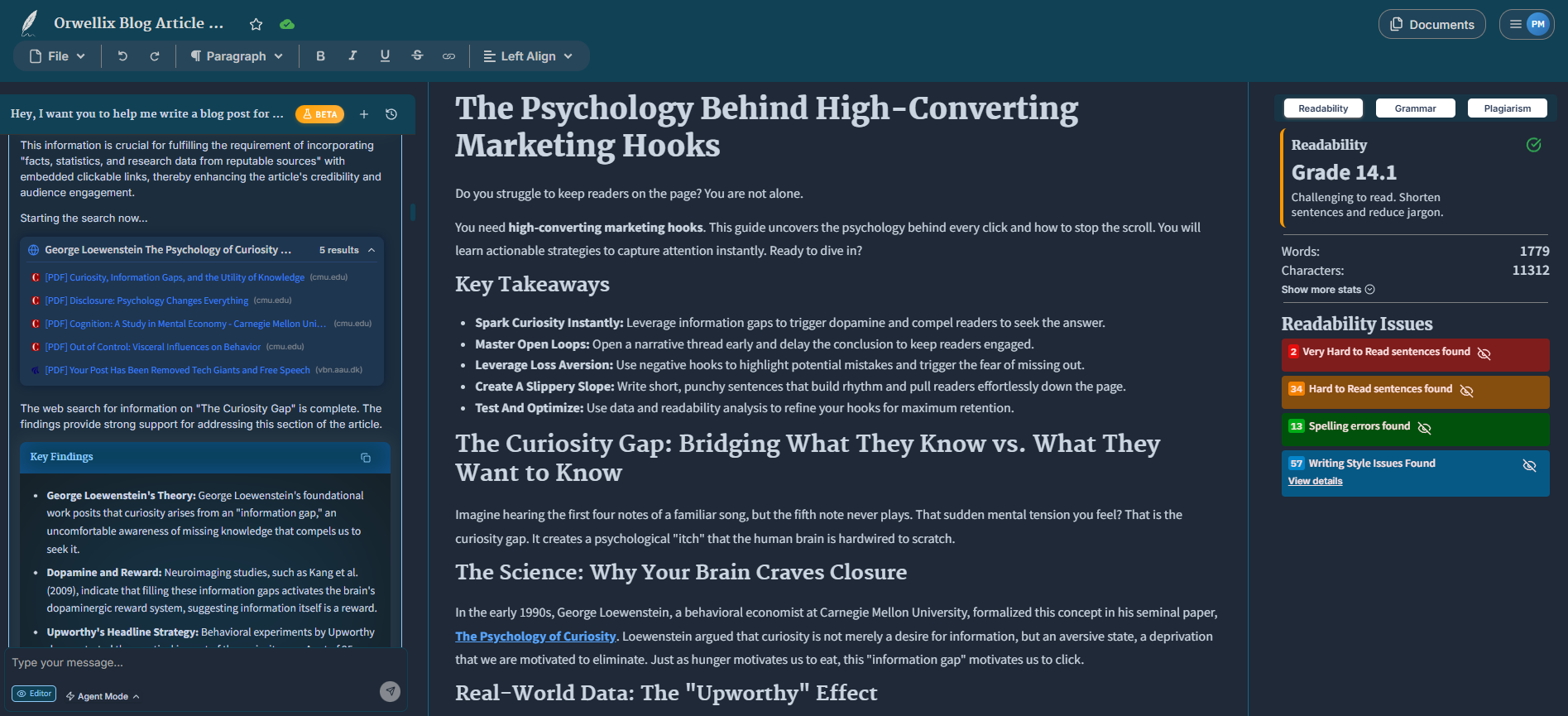
Instead of acting like only a grammar checker or only an AI chatbot, Orwellix presents itself as a writing workspace where drafting, editing, readability analysis, grammar correction, plagiarism checking, and AI-assisted rewriting happen in one place.
For bloggers, long-form writers, quote publishers, caption creators, and content-site owners, that is a strong promise. But the more important question is simple:
Is Orwellix actually useful enough to replace multiple writing tools, or is it just another AI product with good marketing?
In this review, I am evaluating Orwellix from the perspective of a content publisher. That means I am not looking at it as a coding tool, a general AI chatbot, or a business suite. I am looking at it as a platform for people who publish content regularly and need cleaner drafts, faster editing, better readability, and a more organized writing workflow.
If you want to explore the platform directly, you can visit the official Orwellix website. In the review below, I will break down what it does well, where it is different, where it still has limits, and who it is best suited for.
Quick Verdict
Orwellix is not trying to compete as a generic AI chat product.
Its real value is in combining document editing, AI-assisted rewriting, readability scoring, grammar checking, and plagiarism-related workflow into one writing-focused environment.
That makes it more interesting for serious writers than many standalone AI generators.
The strongest part of Orwellix is its product direction: it is built around the idea that AI should work inside the document instead of forcing the user to keep copy-pasting text between different tools. For writers who edit long blog posts, landing pages, web copy, academic drafts, or content-site articles, that is a meaningful advantage.
The main limitation is also clear: Orwellix is best when you are willing to work inside its own writing environment. If your entire workflow depends on Google Docs extensions, Microsoft Word plugins, or general-purpose AI chat outside a dedicated editor, then the fit becomes weaker.
How I Evaluated Orwellix
For this draft review, I evaluated Orwellix based on:
- its homepage positioning and core messaging
- its feature pages for the AI writing agent, grammar checking, readability analysis, plagiarism checking, and document editor
- its pricing page and plan structure
- its comparison pages against tools like Grammarly and ChatGPT
- its broader fit for writers, bloggers, and content publishers who manage regular publishing workflows
This is the right approach for a first editorial draft because it helps assess the product’s workflow, structure, and value proposition honestly.
That said, if you plan to publish this review as a final article, you should add your own direct usage notes in at least three places:
- What the editor felt like in real use
- How useful the AI edits were on one real article
- Whether the readability and grammar feedback felt practical or noisy
Those additions will strengthen the Experience part of EEAT significantly.
What Orwellix Is
Orwellix is an AI-powered writing platform designed for people who create and improve written content.
Its positioning is not “generate text quickly.”
Its positioning is closer to this: write, edit, analyze, and improve your document in one place, with AI helping directly inside the writing workflow.
That difference matters.
Many AI tools still behave like chatboxes. You paste text in, ask for a rewrite, receive output, then manually decide where to place it. Orwellix tries to reduce that friction by turning AI into part of the document workflow itself.
Based on Orwellix’s current pages and product messaging, the platform revolves around these core areas:
- AI writing assistance with Ask Mode and Agent Mode
- real-time grammar and writing analysis
- readability scoring and sentence-level difficulty feedback
- plagiarism checking
- document storage and document management
- import and export support for multiple writing formats
In simple words, Orwellix is trying to become a writing stack, not just a writing feature.
The Biggest Differentiator: AI That Works Inside the Document
The most important idea behind Orwellix is that the AI is meant to work within the writing environment rather than outside it.
This is the product angle repeated throughout the site, and it is also the main reason the platform stands out.
For writers, this matters because one of the biggest inefficiencies in modern content work is tab switching.
You start writing in one place. Then you use another tool to fix grammar. Then another tool to improve readability. Then a chatbot to rewrite awkward paragraphs. Then another tool to check originality. The result is a broken workflow and a distracted writer.
Orwellix tries to solve that by keeping the editing process centered on the document.
Its Agent Mode is positioned as the feature that can read the document, propose changes, and help rewrite or refine content directly in context. That is much more appealing than a generic AI chat workflow for anyone who writes full articles rather than isolated snippets.
If this feature performs well in practice, it is easily the strongest reason to consider Orwellix.
Core Features That Matter Most for Writers
1. AI Writing Assistant
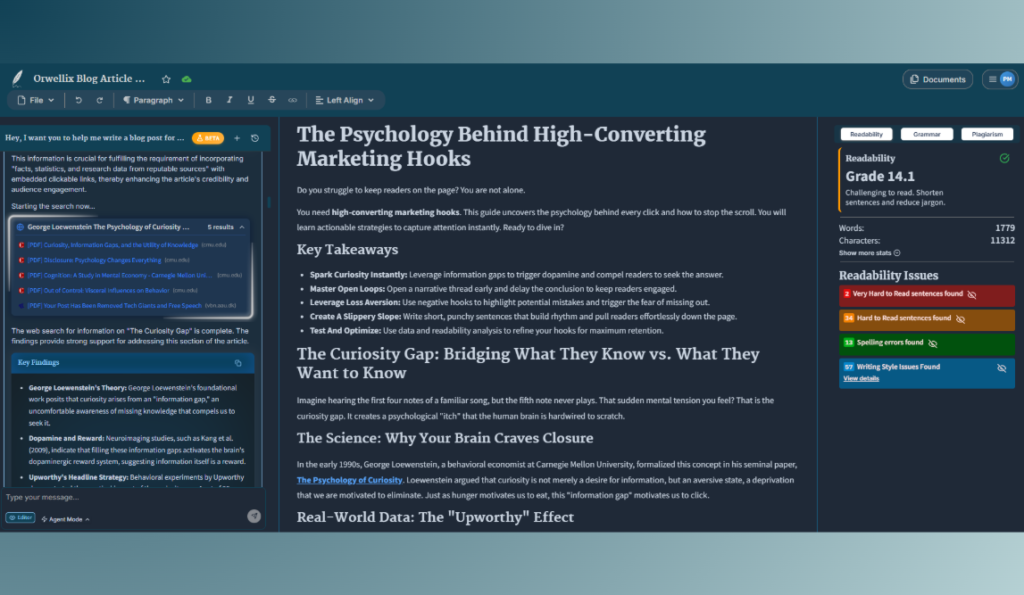
Orwellix appears to separate its AI experience into two layers:
- Ask Mode for conversational help and quick writing tasks
- Agent Mode for more involved editing and rewriting work inside the document
This is a useful distinction.
Writers do not always need a full-document rewrite. Sometimes they just need help with a title, a paragraph transition, a tone adjustment, or a summary. In those cases, a lighter AI mode makes sense.
At the same time, long-form writers often need more than suggestions. They need the tool to help improve structure, clarity, and phrasing across a full piece. That is where Agent Mode becomes the more important feature.
For bloggers and publishers, this could be especially useful when:
- polishing rough drafts
- simplifying hard-to-read sections
- rewriting repetitive paragraphs
- adjusting tone for different audiences
- strengthening introductions and conclusions
2. Grammar and Writing Analysis
Grammar tools are easy to find, but not all grammar tools are equally helpful.
What looks promising about Orwellix is that it does not seem to stop at basic typo correction. Its positioning includes broader writing analysis such as passive voice, adverbs, qualifiers, filler language, and style-related issues.
That is more useful for article writing than basic spellcheck.
For a content publisher, the real goal is not simply “no grammar mistakes.” The goal is cleaner, sharper writing that reads confidently and wastes fewer words.
If Orwellix surfaces grammar and style issues in a way that is practical and not overwhelming, this becomes one of its most valuable everyday features.
3. Readability Analysis
This is one of the areas where Orwellix looks more specialized than many generic AI tools.
Most content publishers underestimate readability.
They focus on keywords, headings, and word count, but if the article feels dense, the user experience drops. On quote sites, poetry pages, blog posts, and informational articles, readability strongly affects how long people stay, how much they understand, and whether the page feels polished.
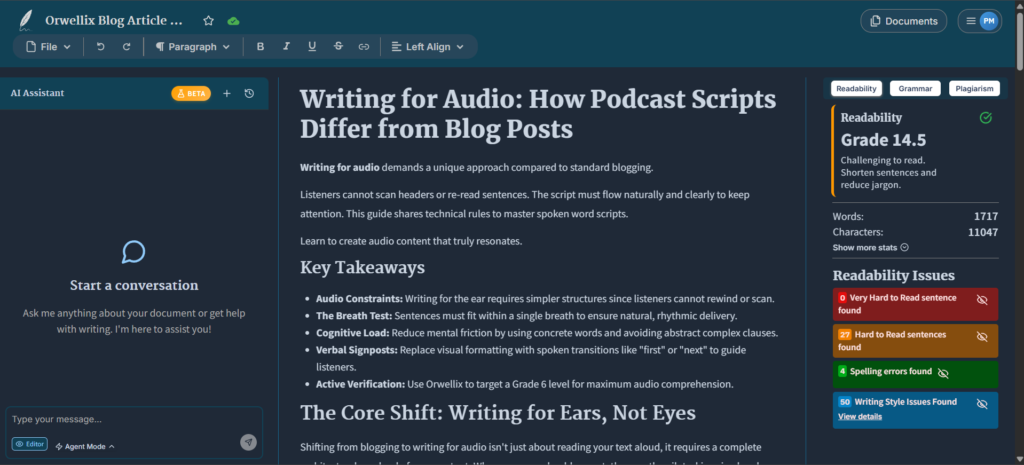
Orwellix puts notable emphasis on readability analysis, sentence difficulty, and clarity scoring. That makes the platform relevant not just for business writing but also for digital publishers who want their content to feel easier to consume.
For website owners, this is practical because readability problems often hide in:
- extra-long sentences
- repetitive sentence openings
- filler-heavy paragraphs
- vague phrasing
- unclear transitions
If Orwellix helps solve those issues inside the editor, it offers more than a normal AI text generator.
4. Plagiarism Checking
Plagiarism detection is not needed for every single writing task, but it matters a lot for professional publishing.
Anyone working with AI-assisted content should care about originality checks, especially if they publish articles, guides, educational pages, or informational blog posts.
Orwellix includes plagiarism checking in its overall writing workflow. That is an advantage because it reduces the need for another external tool.
For site owners, this matters for both quality control and risk reduction.
5. Document Workspace and Export Workflow
Another useful part of Orwellix is that it is structured as a document platform, not just a text box.
That sounds small, but it changes the experience.
Tools that support document storage, autosave, imports, exports, and full writing sessions are usually much better suited to serious publishing work than tools designed only for isolated prompts.
For bloggers, niche site owners, and regular content writers, this makes Orwellix feel more like a working environment than a one-click generator.
Where Orwellix Looks Strongest
After reviewing the product structure and positioning, these are the areas where Orwellix appears strongest.
It Solves a Real Workflow Problem
This is the main reason the product feels credible.
The problem it addresses is real: writers using too many tools to complete one piece of content.
That workflow problem is easy to understand, and Orwellix is clearly built around solving it.
It Is More Specialized Than a Generic AI Chatbot
General AI tools are flexible, but flexibility is not the same as workflow fit.
Writers need context, revision control, readability guidance, grammar feedback, and document continuity. Orwellix seems much closer to that use case than a standard AI chat interface.
It Has a Clear Use Case for Publishers
This part matters for a site like donshayari.in.
Even though DonShayari is a poetry and quote-focused site, the broader job is still content publishing. Titles, intros, category descriptions, article explanations, quote context sections, and supporting text all need writing help.
That means an Orwellix review can fit your audience if the framing is about writers, bloggers, and content publishers, not random software buyers.
It Combines Analysis With Action
Some tools only detect issues. Others only generate text.
Orwellix is more interesting because it tries to do both: identify writing problems and help fix them within the same environment.
That combined workflow is stronger than having isolated features with no continuity between them.
Where Orwellix May Not Be the Best Fit
A review should not only praise the product. It should also explain where the tool may fall short for certain users.
It Depends on You Using a Dedicated Writing Workspace
If someone wants all writing help to happen inside Google Docs, Word, Gmail, or browser extensions, Orwellix may not feel as seamless as tools built specifically around those ecosystems.
Its strength is the dedicated workspace model. But that same strength can feel like a limitation for users who do not want to change where they write.
It Is Not a General AI Tool for Everything
This is actually fine, but it should be stated clearly.
If someone wants one AI tool for coding, spreadsheets, business automation, design help, casual Q and A, and writing, then Orwellix is probably too specialized.
Its value is strongest when the buyer mainly cares about writing and editing.
The Real Test Is Still Execution Quality
The concept behind Orwellix is strong.
But in writing tools, concept alone is not enough. The real questions are:
- How accurate are the grammar and style suggestions?
- How useful are the AI rewrites?
- Does the readability feedback genuinely improve content?
- Does Agent Mode save time or create extra review work?
Those are the questions that should be answered with first-hand use before the review is finalized.
Orwellix Pricing: Does the Value Make Sense?
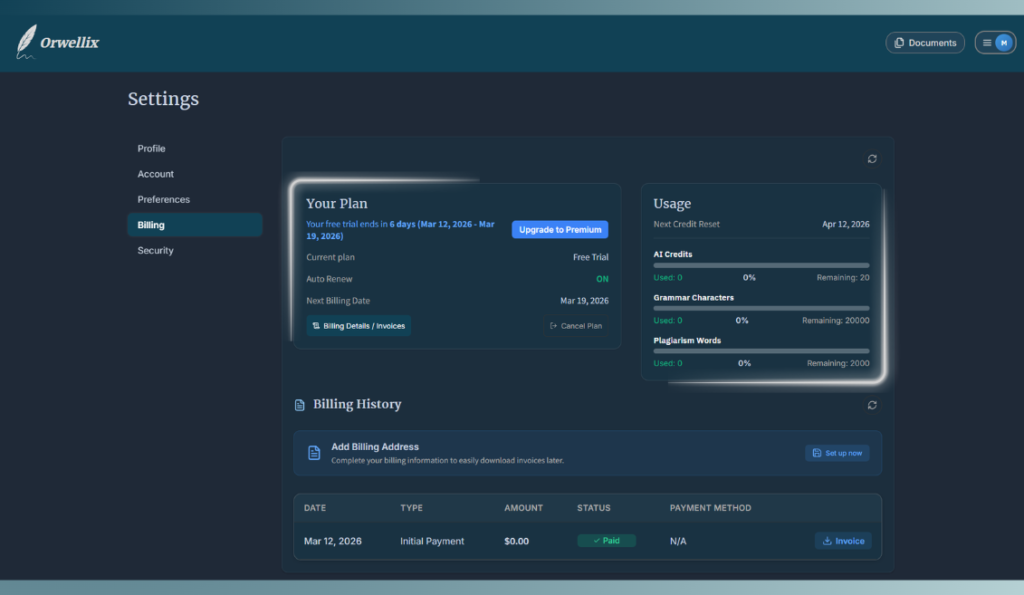
Orwellix currently positions itself with paid plans rather than a fully free long-term workflow.
That means the value question is important.
The platform makes the most sense for users who are currently piecing together multiple paid or semi-paid tools for writing.
For example, if a writer is already paying separately for:
- an AI writing assistant
- a grammar checker
- a readability aid
- a plagiarism checker
then an integrated writing platform can make financial sense if it genuinely replaces enough of that stack.
On the other hand, if someone only occasionally writes content and mainly needs basic AI help, they may not use enough of Orwellix’s deeper workflow to justify the subscription.
So the pricing decision should depend on writing frequency, not just feature count.
In my view, Orwellix is better suited for:
- regular bloggers
- freelance content writers
- affiliate marketers
- niche site owners
- academic and professional writers
- teams that publish consistently
It is less suited for:
- casual users who write only occasionally
- people who only need a chatbot
- users who refuse to work inside a dedicated editor
Who Should Consider Orwellix
Orwellix looks like a good fit for:
Bloggers and niche site owners
If you publish articles regularly and care about clarity, structure, and editing speed, Orwellix’s all-in-one writing workflow is appealing.
Content writers and copywriters
If your daily work includes drafting, rewriting, polishing, and improving multiple pieces of content, the integrated workflow could save time.
Writers who currently juggle multiple tools
This is the most obvious audience.
If your current process involves ChatGPT for drafts, Grammarly for correction, Hemingway for readability, and another tool for originality checks, Orwellix is directly trying to replace that stack.
Publishers who care about writing quality, not just generation speed
A lot of AI tools are built around speed alone.
Orwellix appears more aligned with quality control, document improvement, and writing workflow, which is better for people who publish under their own brand.
Who Should Skip Orwellix
Not every writing tool is for every writer.
You may want to skip Orwellix if:
- you only need a simple free AI chat tool
- you write very rarely
- you want a browser extension more than a writing workspace
- your workflow is locked into another editor and you do not want to move
- you are looking for a broad general AI assistant rather than a writing-focused platform
My Overall Opinion on Orwellix
Orwellix has one of the more focused and sensible product directions I have seen among newer AI writing tools.
It does not try to be everything.
It tries to solve a clear problem for writers: too many disconnected tools, too much copy-pasting, and not enough editing help in the actual writing environment.
That makes the platform more serious than many shallow AI generators.
The strongest part of Orwellix is not just that it uses AI. Almost every tool says that now.
The stronger point is that it tries to organize the full writing workflow inside one platform: drafting, editing, grammar improvement, readability feedback, and document-level assistance.
That is a valuable direction for bloggers and publishers.
At the same time, I would not present Orwellix as perfect for everyone.
Its value depends heavily on how much writing you do and whether you want a dedicated workspace. For the right user, that can be a major strength. For the wrong user, it can be unnecessary.
So the honest verdict is this:
Orwellix looks most compelling for serious writers and content publishers who want a writing-focused platform rather than another generic AI tab.
Final Verdict
Orwellix is a promising AI writing platform with a clearer workflow advantage than many general-purpose AI tools.
Its biggest strength is that it treats writing as a process, not just a prompt.
For bloggers, content publishers, and writers who care about readability, editing quality, and workflow efficiency, Orwellix is worth serious consideration.
If your goal is to reduce tool switching and keep writing, analysis, and AI assistance in one place, Orwellix has a strong value proposition.
If your goal is only to generate quick text with minimal commitment, you may find simpler tools more suitable.
For the audience that wants a dedicated content workspace, though, Orwellix stands out for the right reasons.
FAQ
1. Is Orwellix only for professional writers?
No. It appears suitable for bloggers, students, content-site owners, marketers, and other people who write regularly. But the value becomes stronger as writing frequency increases.
2. Is Orwellix better than ChatGPT for writing?
They serve different purposes. ChatGPT is a general AI tool. Orwellix is more focused on writing workflow, document editing, and writing analysis.
3. Is Orwellix better than Grammarly?
Not in every scenario. Grammarly remains strong for extension-based writing help across apps. But Orwellix looks more complete as a dedicated writing workspace.
4. Is Orwellix useful for bloggers and affiliate marketers?
Yes, especially if the work involves drafting, rewriting, editing, improving readability, and checking content quality before publishing.
5. Can a quote or shayari site owner benefit from Orwellix?
Yes, not because the tool writes poetry automatically, but because site owners still need introductions, article copy, category text, captions, explanations, and polished supporting content around their main quotes or shayari collections.